| Brand Name: | OEM |
| Model Number: | QJB |
| MOQ: | 1 |
| Price: | 900USD |
| Payment Terms: | T/T,Western Union |
| Supply Ability: | 30 NOS PER MONTH |
QJB Anti-Entanglement Submersible Mixer
Product Overview
The QJB anti-entanglement submersible mixer is a specially designed underwater mixing device developed to address the common issues of entanglement and clogging faced by conventional submersible mixers in complex media such as wastewater and sludge. Through optimized structural design and power transmission system, this equipment ensures long-term stable operation underwater, effectively achieving efficient mixing, blending, and flow promotion of liquid media. It enhances medium uniformity throughout water treatment processes and provides consistent operating conditions for subsequent treatment steps such as aeration, sedimentation, and biochemical reactions. Designed in compliance with safety and reliability standards for underwater equipment, it combines ease of installation with cost-effective maintenance, making it suitable for a wide range of municipal and industrial water treatment applications.
2. Operating Conditions
Medium Conditions: Suitable for treating wastewater, sludge, or mixed liquids containing suspended solids, fibers, flocs, and other impurities. The medium temperature range is 0°C to 40°C, pH range is 6.0 to 9.0, medium density should not exceed 1100 kg/m³, and suspended solids concentration should not exceed 5000 mg/L (custom solutions available for special operating conditions).
Environmental conditions: The equipment must operate fully submerged underwater, with a diving depth range of 1.0m to 15m (adjustable according to actual requirements). The working environment should be free from strong vibrations or impacts, and should not contain corrosive gases or flammable/explosive substances. Power supply is three-phase AC 380V/50Hz (customizable for special voltages), with voltage fluctuations not exceeding ±10% of the rated voltage.
Operating conditions: The equipment must operate at the specified medium liquid level; starting under no-load (without submersion in the medium) is prohibited. Continuous operation time should be no less than 8,000 hours per year, and intermittent operation is permitted (with start-stop intervals complying with equipment operating specifications).
III. Application Scope
Municipal Water Treatment: Suitable for aeration tanks, anaerobic tanks, anoxic tanks, sludge thickening tanks, and equalization tanks in municipal wastewater treatment plants, used to mix sewage with activated sludge, prevent sludge settling, and enhance biochemical reaction efficiency. It can also be applied for water quality homogenization mixing in urban stormwater detention basins.
Industrial water treatment: covers wastewater treatment systems for industries such as chemical, pharmaceutical, printing and dyeing, and food processing, including water quality adjustment and mixing in the pretreatment stage, sludge mixing in biochemical treatment tanks, and circulation and uniformity maintenance in industrial recirculating water systems. It can also be applied to sludge mixing and preventing caking in industrial sludge treatment.
Other applications include oxygenation and circulation mixing in aquaculture (improving farming environments), water disturbance in river and lake ecological restoration (promoting water exchange and inhibiting algal growth), and leachate mixing in landfill leachate treatment ponds.
IV. Working Principle
The QJB-CR anti-entanglement submersible mixer is powered by a submersible motor, which transmits power through a coupling to the reduction gear unit. The reduction mechanism converts the motor's high-speed rotation into low-speed, high-torque rotation of the impeller. The impeller features a specially designed streamlined shape that generates both axial thrust and radial stirring force during rotation: the axial thrust drives the liquid along the axis of the equipment, creating directed water flow; while the radial stirring force induces circular motion in the surrounding medium, promoting dispersion and mixing.
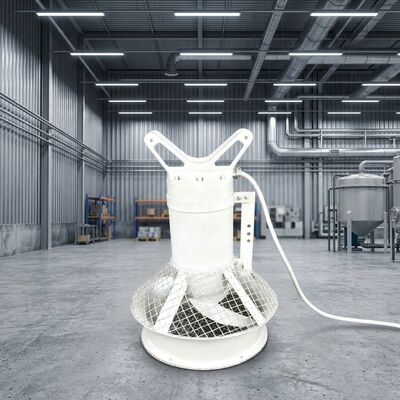
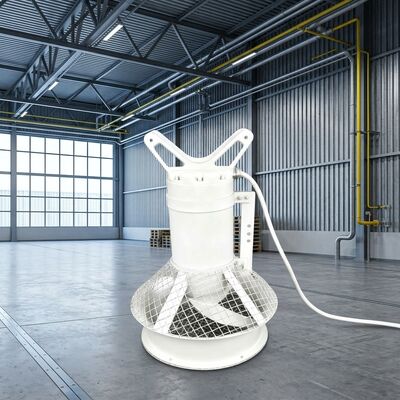
Meanwhile, the anti-entanglement design is a key technical highlight: a protective grille shield is installed between the impeller and the motor housing. This grille structure ensures smooth liquid flow while effectively blocking fibers, hair, and strip-like debris from entering the gap between the impeller and motor. Additionally, the edges of the impeller blades are specially smoothed to minimize debris adhesion. The impeller's rotational direction and angle are engineered to generate a "cutting-type" water flow, further reducing the likelihood of debris wrapping around the impeller. This design ensures long-term stable operation of the equipment and prevents issues such as power overload and device damage caused by entanglement.
5. Product Structure
The QJB anti-entanglement submersible mixer features an integrated underwater design, primarily composed of the following core components:
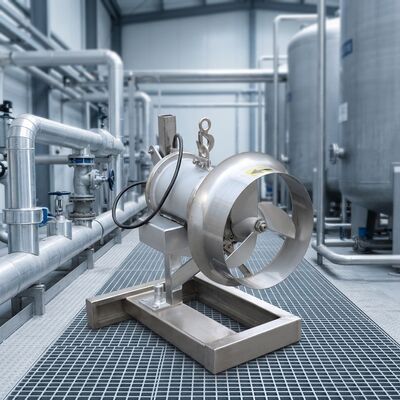
Submersible motor: A three-phase asynchronous submersible motor is used, with a stainless steel housing (304 or 316L, selected according to operating conditions), offering excellent corrosion resistance and sealing performance. The motor is equipped with built-in overheat protection and leakage current protection devices, which automatically cut off the power supply when the motor temperature exceeds the rated value or leakage occurs, ensuring equipment safety.
Gear Reduction Unit: Utilizes a planetary gear or worm gear reduction structure, with the gear ratio designed according to equipment power and mixing requirements. This effectively reduces rotational speed while increasing torque, ensuring sufficient stirring force for the impeller. The internal components are filled with specialized lubricant, providing excellent lubrication and heat dissipation performance, thereby extending service life.
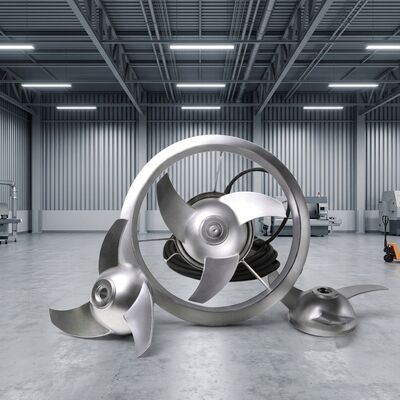
Impeller: The impeller is made of reinforced engineering plastic (such as PPO) or stainless steel, typically featuring 3 to 4 blades with a swept-back, streamlined design that reduces water resistance and enhances mixing efficiency. The impeller is connected to the output shaft of the gearbox via a key connection, ensuring secure installation and convenient disassembly.
Anti-entanglement guard: Located on the outer side of the impeller, it is securely connected to the motor housing and made of stainless steel. The grille spacing is designed according to common impurity sizes (typically 10mm–20mm), effectively preventing large debris from entering the impeller area while allowing unrestricted water flow. The guard's edges feature rounded transitions to prevent scratches on operators or piping.
Sealing system: Features a dual-sealing structure combining mechanical seals and skeleton oil seals. The mechanical seal is made of corrosion-resistant silicon carbide-silicon carbide or silicon carbide-graphite materials, effectively preventing water from entering the motor interior. The skeleton oil seal serves as auxiliary sealing, further enhancing sealing reliability and ensuring long-term underwater operation without leakage.
Installation and mounting components: including guide rods, lifting devices, and base plates; the guide rods are used for equipment installation and removal, enabling maintenance personnel to easily lift the equipment from underwater using the lifting device; the base plate is fixed to the bottom of the tank to ensure operational stability and prevent equipment displacement caused by water flow impact.
6. Product Features and Advantages
Highly effective anti-entanglement design for more stable operation: Featuring an anti-entanglement guard and optimized impeller design, it significantly reduces the risk of debris entanglement at the source. Compared to traditional submersible mixers, the entanglement failure rate is reduced by over 80%, minimizing downtime for cleaning and extending continuous operating time.
High mixing efficiency and lower energy consumption: The streamlined impeller design, combined with an optimized gear ratio, concentrates stirring force more effectively, enabling a wider range of medium mixing at the same power level, improving mixing uniformity by 15%–20%. Meanwhile, the efficient integration of the motor and gearbox reduces energy loss, achieving 10%–15% greater energy savings compared to traditional equipment.
Highly corrosion-resistant and widely applicable: Core components are made of corrosion-resistant materials such as stainless steel and reinforced engineering plastics, capable of withstanding various corrosive media including municipal sewage and industrial wastewater. The materials offer high strength, excellent impact resistance, and aging resistance, enabling a service life of 8 to 10 years under normal maintenance conditions.
High safety performance and convenient operation: The motor is equipped with multiple built-in protection devices to prevent potential hazards such as overheating and electrical leakage. The modular design of the equipment allows for easy disassembly and replacement of components, enabling maintenance personnel to perform routine upkeep without requiring extensive training. Additionally, the device operates at low noise levels (underwater noise ≤60 dB), minimizing environmental disturbance.
High adaptability and flexible application: The equipment can be customized in terms of power (0.75kW–37kW), impeller diameter (200mm–800mm), and submersion depth according to the dimensions and medium characteristics (such as suspended solids concentration and viscosity) of different treatment tanks, meeting personalized requirements across municipal, industrial, and ecological restoration applications. Additionally, it supports standalone operation or multi-unit coordinated control, and can be integrated with the PLC control system of water treatment plants for automated operation.
![]()
![]()