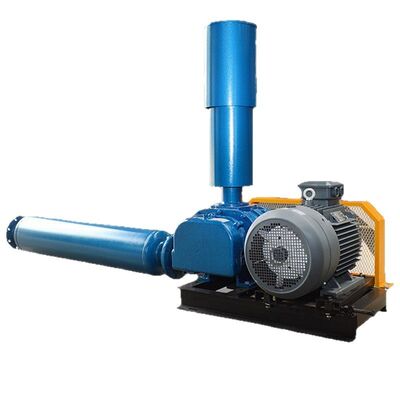
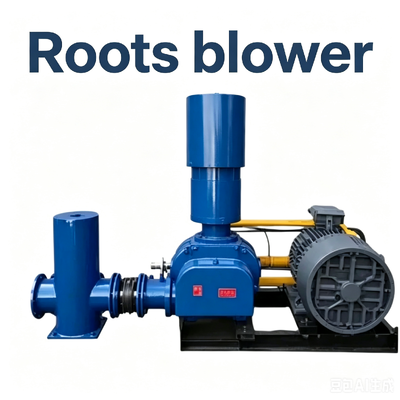
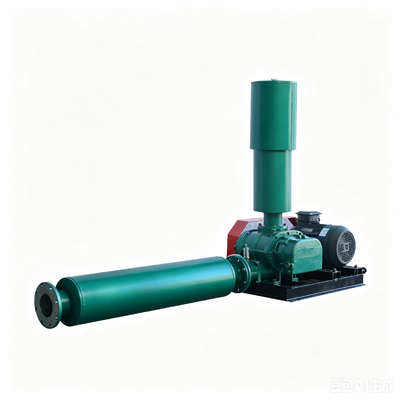
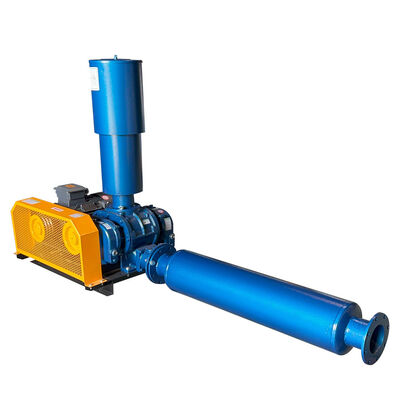
A Roots blower is a positive displacement rotary blower. It forcibly conveys gas via two counter-rotating impellers, featuring constant flow rate, simple structure and oil-free gas delivery.
2. Working Principle and Structure
A Roots blower adopts two figure-8 shaped rotors moving relatively inside the cylinder. The volume of the working chamber changes periodically to suck in and discharge gas.
Its core characteristics are as follows:
Forced gas delivery: Air volume is barely affected by pressure fluctuations; the output flow remains stable at a fixed rotating speed.
No internal compression: Gas is only displaced inside the casing without volume compression, and pressure rise is realized by backpressure.
Structural composition: It mainly consists of a pair of precision impellers (two-lobe or three-lobe type), drive system and sealing devices.
Compared with two-lobe impellers, three-lobe ones deliver smaller airflow pulsation and lower noise.
3. Main Advantages and Disadvantages
Advantages
Excellent stability: Flow barely changes within the allowable pressure range during operation adjustment.
Easy maintenance: Simple overall structure, low unit vibration and long service life.
Pure medium delivery: The conveyed gas contains no oil, suitable for scenarios requiring high gas cleanliness.
Cost-effective: Its price is approximately one-fifth of a magnetic levitation blower, making it ideal for small and medium-sized enterprises.
Disadvantages
High operating noise: Noise generates when air flows through the outlet, so silencers or sound insulation enclosures are generally required.
Limited efficiency: Its efficiency drops significantly under high-pressure working conditions.
4. Application Scenarios
Roots blowers are widely used in various industrial sectors:
Environmental water treatment: Aeration systems for sewage treatment to supply oxygen for biodegradation.
Pneumatic conveying: Transportation of powdery and granular materials such as cement, flour and coal powder in chemical and building material industries.
Industrial manufacturing: drying, dehydration and cooling in food processing, mine ventilation, coal powder conveying in power plants, etc.
Other fields: Aquaculture oxygenation, waste gas treatment, vacuum packaging and so on.
5. Selection and Maintenance Recommendations
Key factors to consider during model selection: required air volume, operating pressure and medium properties (temperature, humidity).
During operation, ensure clean intake air, inspect the lubrication system regularly, and monitor operating parameters to avoid abnormal conditions.
If low noise is a priority, three-lobe rotors matched with noise reduction accessories are recommended.